

![[Logo: Institute for Automotive Engineering (ika)]](https://www.ika.rwth-aachen.de/images/ika-logo-a-blau-blau-rgb.svg)
Thursday, January 15, 2026 · 340 words · 2306 characters
“Dynamic Charging”: RWTH Proves Practicality of Converted E-Trucks
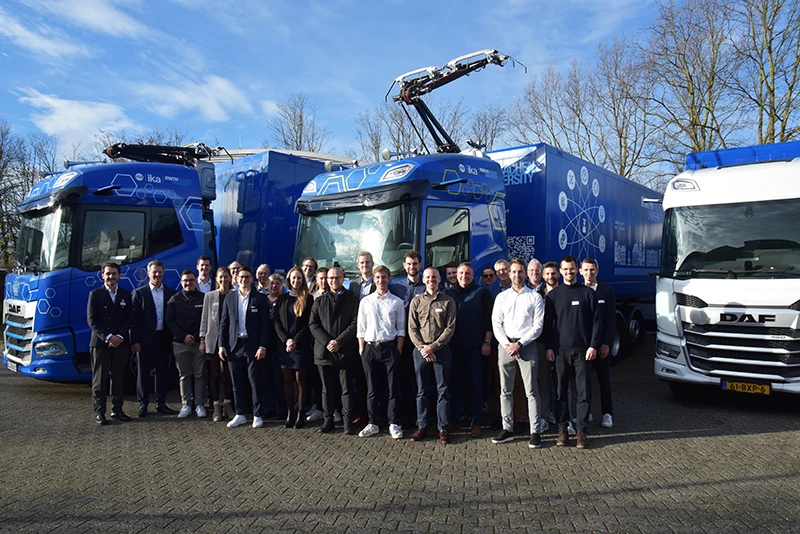
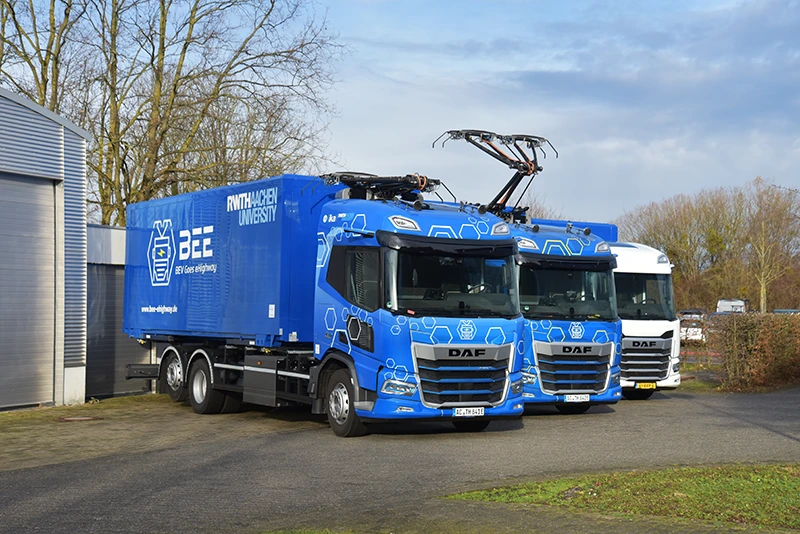
Aachen – The Institute for Automotive Engineering (ika) and the Chair of Production Engineering of E-Mobility Components (PEM) of RWTH Aachen University have jointly developed a retrofit concept for electric series trucks in the successfully completed “BEV Goes eHighway – BEE” research project. In close collaboration with vehicle manufacturer DAF Trucks, two battery-powered “DAF XD Electric” models were upgraded with a newly developed pantograph system. Having been tested in real-world traffic, the system allows the vehicle’s battery to be charged from an overhead line while driving, enabling a reduction in battery size and an increase in operational flexibility.
“Dynamic charging while driving is an important component in the technology mix for decarbonizing freight transport in an ecologically and economically sustainable manner,” says ika Director Professor Lutz Eckstein. The aim of the BEE project was not only to develop a cost-effective retrofit solution for pantograph systems, but also to analyze the existing interfaces for easy integration into standard electric trucks from various manufacturers and to derive a proposed standard for the necessary adjustments. “Powering the battery via overhead lines can help reduce stationary charging and the associated delivery times,” says PEM Director Professor Achim Kampker. The project also investigated potential savings in terms of battery size, the impact on battery aging behavior, and the investments into the retrofit system as part of a “total cost of ownership” analysis.
After developing, building, and integrating the retrofit concept into the “Maja” and “Willi” truck prototypes in the summer of 2024, the system was homologated in both vehicles in accordance with legal requirements. After receiving official road approval, the two trucks completed comprehensive test drives as part of the ELISA, FESH, and eWayBW field trials to prove the system’s suitability for use in public road traffic. Together, the two vehicles covered more than 10,000 test kilometers. The research project was funded by the German Federal Ministry for the Environment, Climate Action, Nature Conversation and Nuclear Safety and supervised by VDI/VDE Innovation + Technik.
About the Chair of Production Engineering of E-Mobility Components (PEM) at RWTH Aachen University
The Chair of Production Engineering of E-Mobility Components (PEM) at RWTH Aachen University was founded in 2014 by StreetScooter co-inventor Professor Achim Kampker, who, in addition to his expertise in electric mobility components and concepts in teaching and research, also has many years of experience in managing start-ups and established companies. In numerous research groups, the PEM team is dedicated to all aspects of the development, manufacture, testing, and recycling of battery systems, electric motors, hydrogen technologies, and their respective components, as well as their integration, particularly in heavy commercial vehicles. The institute specializes in digitalization, sustainability assessment in production engineering, and new battery technologies.
A total of 73 researchers, 31 non-scientific staff, and around 90 student assistants are employed at the German-Dutch Avantis business park and on the RWTH Aachen Campus. The PEM team is active in teaching, nationally and internationally funded research projects, and collaboration with renowned industry partners. The focus is always on sustainability and cost reduction – with the aim of creating a seamless “innovation chain” from basic research to large-scale production in the immediate vicinity. In this context, the PEM chair provides fertile ground for partly networked spin-offs and mobility products.
About Institute for Automotive Engineering (ika) of RWTH Aachen University
As part of RWTH Aachen University, the Institute for Automotive Engineering (ika) researches the entire vehicle, including its systems and their interactions. From the initial idea through innovative component and system concepts to vehicle prototypes, the Institute's employees are shaping the vehicle of the future. The ika makes a recognized contribution to solving current and future challenges both in public projects and in cooperation with automobile manufacturers and suppliers.
The basis of our intensive research work for large parts of the automotive industry as well as public funding bodies at EU, federal and state level is our extensive infrastructure, which ranges from drive, battery, chassis and tire test benches to acoustic, thermodynamic and servo-hydraulic test facilities to a complete vehicle crash facility and test tracks including state-of-the-art measurement technology. In addition, there is up-to-date software and hardware equipment for all necessary simulation disciplines. ika employs about 120 permanent staff and more than 80 student assistants. In addition, around 100 student research and development projects are carried out on a permanent basis.
Released for publication. In case of reprinting, please send us a copy. If you have any questions or would like to receive further material, please contact your contact person.
Press contact
Institute for Automotive Engineering (ika), RWTH Aachen University
Steinbachstr. 7
52074 Aachen
Germany
Nikola Druce M.A.
Head of PR/Media
+49 241 80-25668
Email
Contact
Gordon Witham M.Sc.
Head of Energy & Powertrain Systems
+49 241 80-23919
Email
Images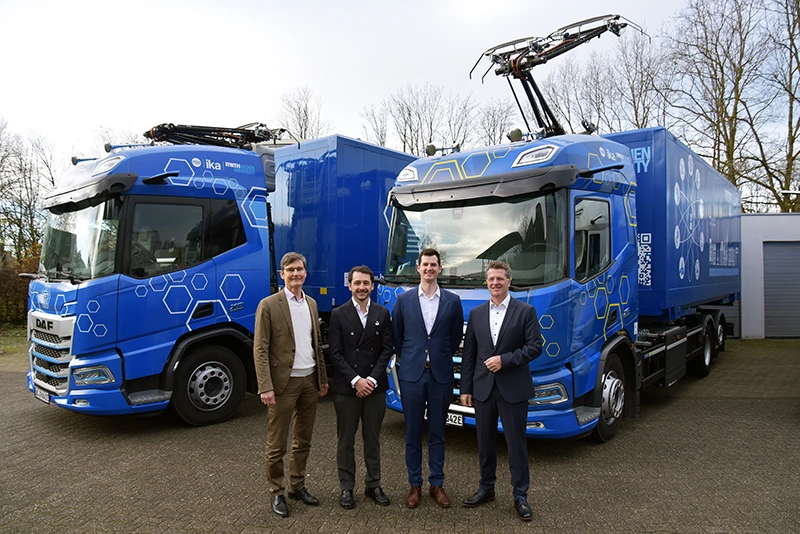



and 5 more pictures
Download
Download PDF of press release.
Download press release with images as zip file. (87.23 MB)
Link
Contact PEM
Mischa Wyboris, M. A.
+49 (0) 160 7898294
m.wyboris@pem.rwth-aachen.de
Service
Cooperations
Address
Institute for Automotive Engineering (ika)
RWTH Aachen University
Steinbachstraße 7
52074 Aachen · Germany
+49 241 80 25600
