


Digital twin road
The chassis as data source for the digital twin of the road system
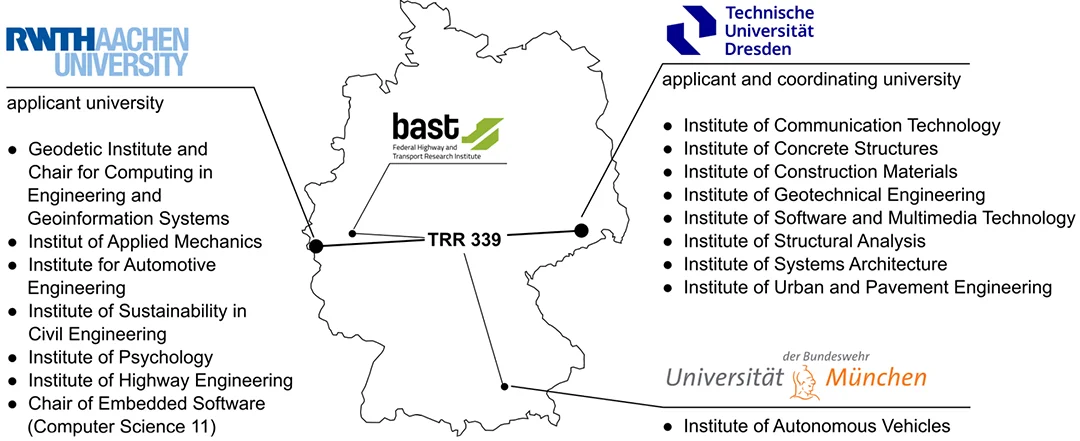
In the Collaborative Research Centre 339 "Digital Twin of the Road System" of the German Research Foundation (DFG), various institutes of RWTH Aachen University and TU Dresden are conducting research on a physical-informational representation of the road system of the future over a period of up to 12 years.
As the main users of the road system, vehicles play a central role in the development of the digital twin. The interaction between the road and the vehicle occurs via the chassis as vehicle subsystem including the tyres. The contact patch between the tyre and the road surface is used for power transmission, which is relevant for vehicle dynamics on the one hand and contains detailed information about the road surface on the other.
Having successfully established the foundations for the chassis as a data source in the first funding period, the Institute for Automotive Engineering (ika) now enters the second phase, in which the chassis takes on an even more central role in the digital representation of the road.
Second funding period: ika is responsible for 3 subprojects
The chassis in the second funding period – from data source to mobile sensor, load balancing and digital shadow architecture
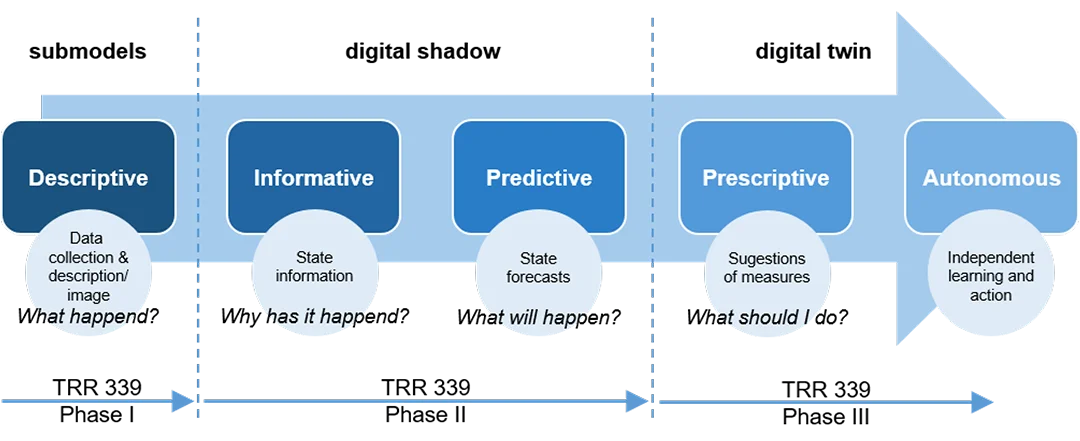
A defining development of the second phase concerns the maturity level of the digital representation itself. While the first phase concentrated on individual submodels, sensor concepts and functionalized materials that describe the road in its individual aspects, the second phase advances these building blocks towards a digital shadow of the road – a high-resolution, data-driven representation of the real infrastructure, created by integrating the individual submodels with real-time data. This digital shadow forms the foundation for predictive infrastructure management and, ultimately in the third phase, for the road as a self-optimizing cyber-physical system.
In line with this growing scope, the single chassis-focused subproject of the first phase has evolved into three distinct subprojects at ika. Building on a shared foundation, each addresses a different facet of the interaction between vehicle, tyre and road within the digital shadow.
The chassis as a mobile sensor for the digital shadow of the road
Building directly on the methodology of the first phase, this subproject transfers the chassis-based sensing approach to the ika research truck and works to systematically reduce the uncertainties of the digital shadow that arise from model- and data-driven approaches. The transition from passenger cars to trucks requires the vehicle dynamics and tyre models to account for different suspension characteristics and load transfer effects. A central objective is to incorporate not only the vertical but also the longitudinal and lateral tyre forces into the digital representation in a spatially resolved manner, enabling a more complete and physically consistent description of the tyre-road contact. In parallel, the tyre model will be extended to capture the effect of tread wear on contact mechanics. Together, these developments pave the way towards mapping non-exhaust emissions – in particular rubber particle release from tyre wear – at high spatial and temporal resolution.
Enhancing durability and sustainability of roads by equalizing road loads on different scales
This subproject uses the digital twin road to enhance the durability and safety of roads by equalizing road loads across different scales, with a particular focus on heavy-duty transport. Key results from the first phase are combined so that a vehicle's influence on the road can be taken into account and actively balanced through its driving behaviour. The digital shadow will be supplemented by a multi-scale simulation with bidirectional information flow, which models the effect of vehicles on the road on several levels — from driving within a road network and the choice of lane through to lateral positioning and the individual load on each wheel. On this basis, an intelligent trajectory planning will be prototypically implemented and evaluated against specific sustainability criteria, providing the fundamental knowledge needed to later integrate such systems into real vehicles and to assess their effect at the level of entire fleets and traffic systems.
Architecture of the digital shadow and development of the demonstrator
This subproject researches and implements a demonstrator of the digital shadow of the road as a complete cyber-physical system — a virtual representation of the physical test environment that enables real-time data acquisition and the execution of subsequent intelligent algorithms. On the physical side, key building blocks from the first and second phases will be deployed at an instrumented asphalt pavement section at the Aldenhoven Testing Center (ATC) in a close cooperation with the BASt and, subsequently, at a complementary concrete pavement section at the Smart Mobility Lab (SML) in Dresden, using a harmonized sensor concept that allows material-dependent effects and transferability to be systematically validated. On the cyber side, a scalable software architecture will be developed that integrates heterogeneous sensors, enables continuous data acquisition and multi-timescale processing, coupling data and models to serve a range of applications — from continuous infrastructure monitoring and predictive maintenance to the load-balancing trajectory planning of Project B09 and the monitoring of non-exhaust emissions.
First Funding Period
The Institute for Automotive Engineering (ika) has integrated the chassis as a data source for the digital twin of the road system.
The aim of our sub-project was to research a concept for obtaining this information in order to provide the digital twin of the road system with real-time data about loads applied by the vehicle and the road condition. By using real load data, in close cooperation with other institutes, measures were derived for the more sustainable use of the road infrastructure by vehicles. In addition to its primary purpose as input data for the digital twin, the data obtained was also highly relevant for the development of future active chassis systems to improve vehicle safety.
As the first component in the load path between the road and the vehicle, the tyre played a central role in this sub-project. However, real-time data on the interaction between tyre and road cannot be collected directly, as a direct measurement of the force distribution in the contact patch is not possible. To meet this challenge, a model-based approach for data generation was chosen. At the core of this approach was a real-time capable tyre model whose input data was provided by a distributed sensor concept in the chassis. In addition to existing sensors in modern vehicles, such as acceleration sensors on chassis components, novel sensors were tested to increase the quality of the input data of the tyre model. Acoustic-based sensor concepts were used, for example, to generate information about the current road surface and the current coefficient of adhesion. Data fusion between the tyre model and the distributed sensor concept ensured the provision of accurate wheel load data in longitudinal, lateral and vertical directions as well as data on the actual road surface condition in real time.

Contact
Dominik Werner M.Sc.
Head of Vehicle Dynamics & Acoustics
+49 241 80-29383
Email
Elaheh Derakhti M. Sc.
+49 241 80-26712
Email
Ventseslav Yordanov M.Sc.
+49 241 80-23890
Email
Project duration
01/2022 – 12/2029
Project partner
14 institutes of RWTH Aachen University and TU Dresden
Project website
Supported by

Participats
Project duration
Phase 1: 01/2022 – 12/2025
Phase 2: 06/2026 – 12/2029
Service
Cooperations
Address
Institute for Automotive Engineering (ika)
RWTH Aachen University
Steinbachstraße 7
52074 Aachen · Germany
+49 241 80 25600
